Security model
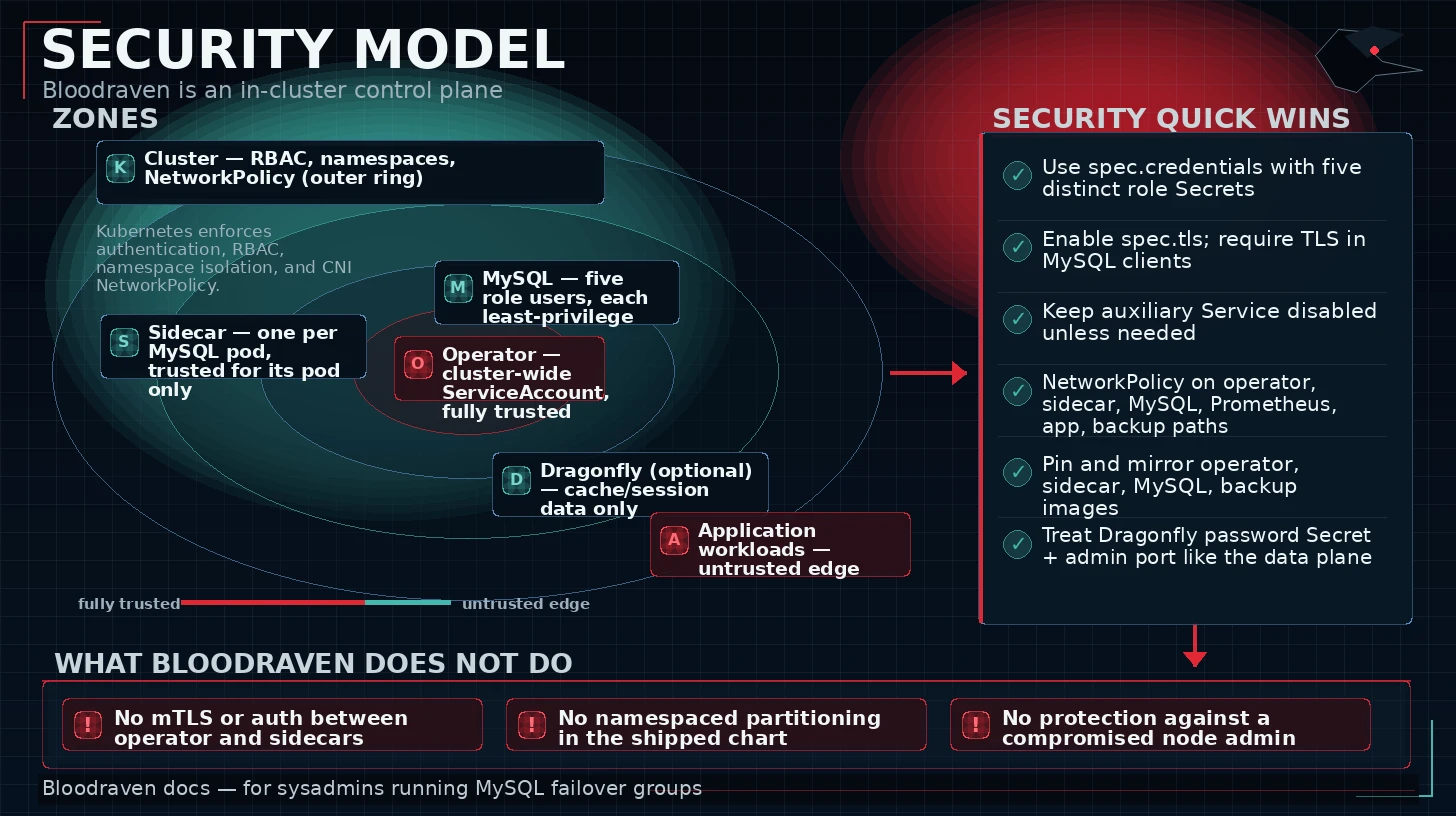
This page documents Bloodraven's security posture: the trust boundaries between its components, the authorizations each component holds, and the blast radius when a specific secret or identity is compromised. It complements Production hardening, which lists the settings to turn on; this page explains why they matter and what remains exposed when they are all correct.
Bloodraven is an in-cluster control plane for a tenant MySQL service. It is not a zero-trust system on its own. It relies on the hosting Kubernetes cluster for authentication, namespace isolation, and network policy. The guarantees below all assume a competent cluster operator is running it.
Security quick wins
- Use
spec.credentialswith five distinct role Secrets. - Enable
spec.tlsand require TLS in MySQL clients. - Keep
auxiliary.service.enabled=falseunless a dashboard or integration needs it. - Add NetworkPolicy for operator, sidecar, MySQL, Prometheus, app, and backup paths.
- Pin and mirror operator, sidecar, MySQL, and backup images.
- If Dragonfly is enabled, protect its password Secret, active Service, and admin port with the same care as the MySQL data plane.
- Link Secret rotation to Credentials And TLS.
Threat-model assumptions
| Assumption | Consequence |
|---|---|
| Kubernetes API authn/authz is trusted | RBAC boundaries are meaningful. |
| CNI enforces NetworkPolicy correctly | Unauthenticated sidecar and auxiliary endpoints can be isolated. |
| Secret storage is protected | MySQL, Dragonfly, TLS, S3, and encryption secrets remain confidential. |
| Node administrators are trusted | A node admin can read mounted Secrets and MySQL data on that node. |
| Application workloads are less trusted than the operator | Apps should only receive app or read-only MySQL credentials. |
Trust model at a glance
Four identities participate in the required MySQL data path. Managed Dragonfly adds an optional cache/session data path when enabled. Everything else in the cluster is considered untrusted.
| Identity | What it is | Trust level |
|---|---|---|
| Operator | Single-replica Deployment running bloodraven, bound to a cluster-wide ServiceAccount. Owns the reconcile loop and DNS writes. | Fully trusted — it is the control plane. |
| Sidecar | Per-MySQL-pod container running bloodraven-sidecar. Serves read-only status HTTP, manages MySQL startup, writes binlog manifests, and self-fences its MySQL. | Trusted for the single pod it runs in. |
| MySQL | mysqld itself, with the per-role users Bloodraven creates (operator, app, readonly, monitor, backup). | Trusted for query execution; each MySQL user is trusted only for its role's grants. |
| Dragonfly | Optional per-site Dragonfly pods created when spec.dragonfly.enabled=true. The operator configures replication, role/traffic labels, and promotion. | Trusted for cache/session data only. Do not store durable application state here. |
| Application | Workloads that connect to the primary/replica Services using appSecret / readOnlySecret. | Untrusted by the operator — apps are tenants. |
All intra-cluster traffic between these identities flows over the pod network. Bloodraven does not authenticate HTTP calls between the operator and the sidecars, and it does not mTLS-protect the sidecar HTTP endpoint. Isolation is the hosting cluster's job (NetworkPolicy, namespace boundaries, CNI-level encryption if you require it).
Authorization — who can do what
Operator ServiceAccount
The operator runs with a cluster-scoped ClusterRole
(config/rbac/role.yaml, mirrored in
charts/bloodraven/templates/clusterrole.yaml). It holds the minimum
set of verbs to reconcile MysqlFailoverGroup and MysqlBackup
resources across any namespace. Notably:
- Full CRUD on
Secrets,ConfigMaps,Services,PersistentVolumeClaims,Jobs,CronJobs,Deployments,PodDisruptionBudgets— cluster-wide. The operator reads credential Secrets, renders MySQL config into ConfigMaps, and creates PVCs, Services, Pods, and Jobs per site. - Full CRUD on
dnsendpoints.externaldns.k8s.io— the failover path writesDNSEndpointCRs thatexternal-dnsthen pushes to the DNS provider. get/list/watch/patchonpodsandnodes, plusgetonpods/log— used for the tainter, the backup-sentinel log tail, and placement contract enforcement.- Full CRUD on
leases.coordination.k8s.io— leader election.
There is no namespaced partitioning. A single operator install
reconciles groups in every namespace. If you need tenant isolation
(one operator per tenant), deploy one operator per namespace scope and
use a Role instead — the code supports this but the shipped chart
does not.
MySQL user roles
When spec.credentials is used, the operator creates five MySQL users
with the following effective grants (see
CRD Reference → CredentialsSpec):
| Role | Effective authority |
|---|---|
operator | ALL PRIVILEGES ON *.* WITH GRANT OPTION — full admin. Used by the operator and sidecar only. |
app | ALL PRIVILEGES ON *.* without GRANT OPTION or SUPER — read/write DML + DDL for tenant workloads. |
readonly | SELECT, SHOW VIEW, SHOW DATABASES, PROCESS — read replicas. |
monitor | PROCESS, REPLICATION CLIENT + SELECT on performance_schema.* — mysqld_exporter and similar scrapers. |
backup | SELECT, LOCK TABLES, SHOW VIEW, EVENT, TRIGGER, RELOAD, BACKUP_ADMIN, REPLICATION CLIENT — MySQL Shell dump jobs. |
The legacy spec.secretName DSN mode collapses all of the above into a
single user whose credentials the DSN carries. Do not use it in
production — it defeats the entire per-role isolation story.
Destructive annotations on the CR
patch on mysqlfailovergroups is the narrow privilege that controls
every operator-initiated destructive action. The annotations the
operator acts on are:
bloodraven.shipstream.io/reclone-site=<site>:<gtid-prefix>— TriggersCLONE INSTANCEon the named site, overwriting its data directory from the current primary. The GTID-prefix confirmation (≥ 8 chars, must match the currentstatus.sites[<site>].divergentGtid) prevents typos from wiping the wrong site. See Failover → Reclone flow.bloodraven.shipstream.io/planned-failover=<site>— Drains writes, honours the anti-flap cooldown, waits for the target to catch up, and promotes the named site. When Dragonfly is enabled, this also drives the Dragonfly sync andREPLTAKEOVERphases.bloodraven.shipstream.io/dragonfly-snapshot-upgrade=<image>— Runs the Dragonfly snapshot-restore upgrade workflow whenspec.dragonfly.snapshotis configured.
An attacker with patch mysqlfailovergroups in the target namespace
can therefore cause a data wipe of one site (bounded by the GTID
confirmation interlock), an unscheduled failover, or a planned Dragonfly
cache/session outage during snapshot-restore upgrade. RBAC on the CRD
is the only gate — scope MysqlFailoverGroup edit rights as tightly
as you would scope kubectl delete pvc.
Network surface
| Listener | Port | Authenticated? | Purpose |
|---|---|---|---|
| Operator metrics | :8080 | No | Prometheus scrape (/metrics). |
| Operator health probes | :8081 | No | Kubernetes liveness/readiness. |
| Operator auxiliary HTTP | :8082 | No | /status, /active-site, /pitr-cutoff, /ws/status (WebSocket). Consumed by the dashboard and by sidecars that check which site is active. |
| Sidecar HTTP | :8080 | No | /health, /status, /peer/ping, /archiver/status. Consumed by the operator and the peer sidecar. |
| MySQL | :3306 | Yes (password; TLS if spec.tls set) | Data plane. |
| Dragonfly client | :6379 by default | Password when spec.dragonfly.auth is set | Optional Redis-compatible cache/session data plane. |
| Dragonfly admin | :9999 by default | Password when spec.dragonfly.auth is set | Optional operator control surface for replication, promotion, and snapshot commands. |
None of the HTTP surfaces above authenticate callers. They expose read-only status and GTID coordinates; none accept state-changing requests. The design assumes the pod network is protected by NetworkPolicy and that the operator + sidecars run in a namespace that does not accept untrusted ingress. In particular:
- Do not expose
:8082outside the cluster. The/active-siteand/statusendpoints do not leak credentials but do leak topology, site names, zone labels, and GTID coordinates — useful reconnaissance for an attacker already inside the cluster. - The WebSocket push stream (
/ws/status) is likewise unauthenticated. Anyone that can reach port8082can read real-time failover events. - If you require scrape auth, front the metrics endpoint with a
sidecar (e.g.
kube-rbac-proxy). The chart does not ship one.
TLS and data-in-flight
When spec.tls.secretName references a Secret with ca.crt,
tls.crt, and tls.key, the operator mounts it into every MySQL pod
and renders config that sets ssl-ca/ssl-cert/ssl-key and
require-secure-transport=ON. Without TLS set, MySQL accepts
plaintext connections from anything on the pod network.
- Replication between sites uses the same MySQL port and the same
server certificate — cross-site replication is TLS-protected only
when
spec.tlsis set. Mirror a single issuer across sites, or ensure both sites' certs chain to a CA each other trusts. - The sidecar, operator, backup Jobs, and MySQL Shell dump workers
all trust the CA in
ca.crt. When you rotate the CA, rotate the mounted Secret; the operator detects the hash change and rolls pods. - Cert-manager integration is not automatic — Bloodraven expects the
Secret to exist. Use a cert-manager
Certificateresource to populate it.
Dragonfly traffic is not covered by spec.tls; configure NetworkPolicy
and, where required, Dragonfly-native TLS or a service mesh outside
Bloodraven's managed flags. Do not expose the Dragonfly admin port to
applications.
Secrets at rest and in memory
- Nothing is written to disk that wasn't already on disk. The
sidecar receives its DSN via
MYSQL_DSNenv var (or reconstructs one fromMYSQL_USER/MYSQL_PASSWORD) and keeps it in memory. It does not write credentials to a file. - Logs never include passwords. DSNs are built for in-process use and are never logged; SQL statement errors are truncated before logging. Operator events and condition messages are safe to ship to a log aggregator.
- Secret content is copied into env and files as MySQL requires.
The MySQL pod's environment holds
MYSQL_ROOT_PASSWORDand the per-role passwords during first boot; after user creation these are no longer required and could be unset, but the operator keeps them in the pod spec for simplicity. Anything that cankubectl execorkubectl describe podcan see them. - Dragonfly auth is optional but recommended for shared namespaces.
When
spec.dragonfly.authis set, the operator projects the password Secret into Dragonfly pods as an environment variable and uses it for its own Redis-protocol connections.
Compromise scenarios
The operator ServiceAccount token leaks
This is the worst-case credential compromise. With operator-level cluster access, an attacker can:
- Read every namespace's Secrets. Including MySQL credential
Secrets for every
MysqlFailoverGroupthe operator manages. Treat this as equivalent to leaking all per-tenant MySQL credentials and all TLS private keys referenced byspec.tls. - Create or patch arbitrary
Deployment,Pod,Job,CronJob,Service, andPVCobjects cluster-wide. Because the operator has full CRUD on these, the attacker has a general-purpose tenancy breakout through pod spec injection. - Write
DNSEndpointCRs that external-dns will push to the public DNS zone, enabling a DNS-hijack attack against any name external-dns manages (not just MySQL names). - Exfiltrate PVC contents by scheduling a pod that mounts the target PVC — the ServiceAccount can create pods and PVC mounts.
- Create or patch Dragonfly StatefulSets and Services when the feature is enabled, including changing cache/session routing labels.
Mitigations. Pin the chart's serviceAccountName, bind it to a
namespace-scoped Role where possible, run the operator in its own
namespace, and rely on the audit log to detect token reuse from
unexpected source IPs. Rotate the token (delete the ServiceAccount's
token Secret) on any suspected compromise — Kubernetes issues a new
projected token to the pod automatically.
This is the single largest blast radius in the product. A multi-operator, namespace-scoped deployment model is on the wishlist but not implemented today.
The MySQL operator / root password leaks
Inside the DB, operator and root are equivalent — both carry
ALL PRIVILEGES ... WITH GRANT OPTION. An attacker with either can:
- Read, modify, or drop any schema. Including running
SELECT ... INTO OUTFILEon any path MySQL can reach (bounded bysecure_file_priv, which Bloodraven sets to the data directory). - Create new MySQL users and grant them arbitrary privileges, surviving a password rotation of the known users.
- Run
STOP REPLICA/RESET REPLICA ALL/CHANGE REPLICATION SOURCE TO ...— directly breaking replication or repointing a replica at an attacker-controlled primary. - Trigger
SHUTDOWN(unlessSUPERis gated), rebooting the MySQL instance.
The blast radius is per-failover-group, not cluster-wide. The
operator will detect the resulting replication breakage and attempt
recovery or raise Degraded=True, but it cannot distinguish malicious
writes from legitimate ones — divergent GTIDs are the only signal that
reaches the status.sites[].divergentGtid field.
Mitigations. Store credential Secrets with a rotating provider
(ESO, sealed-secrets, Vault). Set alerts on
bloodraven_divergent_transactions > 0. Keep the operator's Secret
in the same namespace as the failover group so a namespace-compromise
does not cascade.
The MySQL app password leaks
Bounded by the app grants: read/write across every schema, but no
SUPER, no GRANT OPTION, no REPLICATION privileges. The
attacker cannot:
- Create new MySQL users or escalate within MySQL.
- Break replication (lacks
REPLICATION CLIENT/REPLICATION SLAVE). - Run
KILLon other sessions (lacksPROCESSunless you deviate from the default). - Drop the MySQL server itself.
The attacker can run arbitrary SQL against the tenant data. This is
the same blast radius as an application SQL-injection — assume any
compromise of app yields full data read/write for the application's
schemas.
Mitigations. Rotate appSecret on detection. The operator
propagates password changes via ALTER USER on the next reconcile.
Consumers that cache connection strings need to reconnect.
A sidecar pod is compromised
A sidecar pod shares the pod network namespace with its mysqld.
An attacker with code-execution in the sidecar can:
- Connect to
mysqldon127.0.0.1:3306using theoperatorcredentials the sidecar holds. This is the same authority as "operator password leaks", but scoped to the one MySQL instance. - Self-fence the MySQL (write
read-only=ON, kill its own pod) — the sidecar already does this legitimately, but an attacker can use it for denial-of-service. The peer sidecar will eventually promote, so the net effect is an unscheduled failover. - Write the binlog archive manifest for that site — corrupting
PITR coverage for that site only. Objects already uploaded to the
backup bucket are not deleted by the sidecar; recovery is
possible from the bucket manifest + objects, but
status.pitr.archiveCoverageTowill mislead operators in the meantime. - Read the MySQL data directory — the sidecar's mount point on
/var/lib/mysqlis shared withmysqld.
The blast radius is one MySQL site of one failover group. The attacker does not gain operator-level Kubernetes privileges — the sidecar runs with a minimal ServiceAccount — and does not reach the peer site directly (the peer only trusts its own sidecar and the operator). The worst observable consequence is a forced failover plus data exfiltration from the one site.
Mitigations. Use a distroless sidecar image, keep its process
footprint small, and audit the sidecar image in the same supply-chain
pipeline as mysqld. Alert on bloodraven_failovers_total spikes
that coincide with sidecar restarts.
A backup bucket credential leaks
Bounded by the bucket IAM policy — not by Bloodraven. Bloodraven
passes the credentials (from spec.backup.profiles[].storage.secretRef)
to mysqlsh, mysqlbinlog, and the sidecar archiver as env vars.
With the credential, an attacker can:
- Delete or overwrite backup objects (full dumps and binlogs), destroying the PITR chain.
- Read every dump — they contain the full database content.
Mitigations. Scope bucket IAM to the specific profile's prefix. Enable object-lock / versioning / MFA-delete on the bucket. Rotate bucket credentials independently of MySQL credentials.
The DNS zone trust is compromised
Bloodraven writes DNSEndpoint CRs; external-dns translates them
into DNS records. If the DNS provider or external-dns itself is
compromised, an attacker can repoint MySQL traffic to an
attacker-controlled endpoint. Bloodraven cannot prevent this.
The only mitigation is defense in depth at the DNS layer — zone-
signing, IAM scoping of external-dns, and short TTLs that limit
the window during which a malicious repoint holds.
What Bloodraven does not defend against
Explicit non-goals, so the list above is complete:
- Container escape from
mysqld— Out of scope; treatmysqldas you would any other privileged workload in your cluster. - Kernel-level exfiltration of data in MySQL memory — out of scope; use confidential-computing primitives at the node level if required.
- Malicious application SQL — the operator cannot distinguish a legitimate write from a malicious one. Application-level access control is the app's responsibility.
- Kubernetes API server compromise — nothing below the API server can be trusted if the API server is compromised.
- Supply-chain attacks on the operator or sidecar images — pin and mirror per Production hardening.
- DoS of the control plane — an attacker with
patchon a CR can trigger reconciles at whatever rate the API server allows. The operator is rate-limited by controller-runtime's workqueue, but a motivated abuser can still produce noise.
Hardening summary
If you only read one section, read this. The minimum for a production deployment:
- Use
spec.credentials(per-role) — neverspec.secretName(legacy DSN). - Set
spec.tlsand require it in the MySQL clients. - Scope
patchonMysqlFailoverGrouptightly — it is the reclone and planned-failover vector. - Keep the operator in its own namespace and do not grant its ServiceAccount to anyone else.
- Apply a NetworkPolicy that permits only the operator to reach
sidecar
:8080and the dashboard to reach operator:8082. - Store credential Secrets with a rotating provider and rotate on a schedule.
- Lock down the backup bucket IAM to the prefix the profile uses, and enable versioning / object-lock.
- Subscribe to divergent-GTID alerts (
bloodraven_divergent_transactions > 0) — that is your "someone wrote to the wrong primary" tripwire.
For the full checklist see Production hardening.